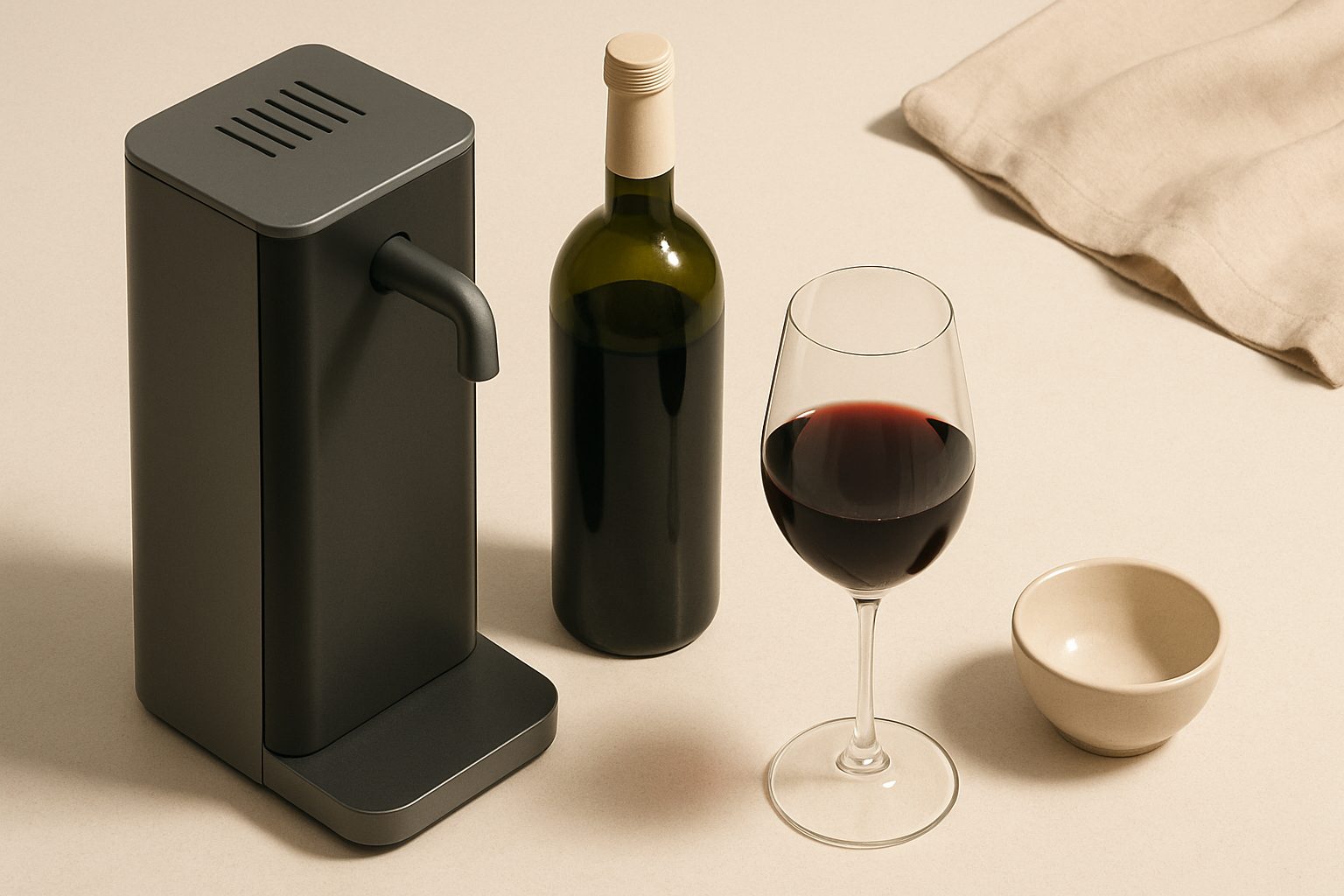
Does a Wine Dispenser Actually Keep Wine Fresh? Honest Test Results
If you've ever left an opened bottle of red on the kitchen counter for three days and watched it turn from a decent Bordeaux into something closer to vinegar, you've encountered oxidation. Wine dispensers promise to fix this—claiming they'll keep your opened bottles fresh for weeks instead of days. But do they actually work? After testing several models and understanding the science behind them, the answer is nuanced: yes, they do slow oxidation, but no, they're not a magic solution.
How Wine Actually Oxidises
Oxidation isn't mysterious. When wine meets air, oxygen begins reacting with compounds in the wine—particularly phenols and tannins. This happens immediately after you open a bottle. A young red wine might stay pleasant for two to three days on your worktop (the cool conditions actually help a bit), but a lighter white or rosé typically turns noticeably duller within 24 hours.
The process accelerates with temperature, light, and surface area exposed to air. A bottle that's corked and laid down can age for decades because very little oxygen is present. An open bottle left upright offers maximum surface area for oxidation to attack. This is why wine people cork bottles immediately—it's not snobbery, it's chemistry.
The bigger issue most people face isn't whether wine oxidises; it's that they want to drink good wine throughout the week without committing to finishing the bottle on day one.
How Wine Dispensers Tackle the Problem
Wine dispensers work on one of two principles: either they replace air with an inert gas (usually argon), or they create a barrier between the wine and the remaining oxygen.
Gas-based systems are the most effective. When you press the tap, a valve opens to pour wine, and when you release it, the valve closes and inert gas is automatically injected into the bottle. Argon is heavier than air and sits on top of the wine, physically blocking oxygen from reaching the surface. This genuinely works because you're removing one of the core conditions needed for oxidation.
Vacuum systems use a pump to remove air from the bottle before sealing it. These are cheaper and work without needing replacement cartridges, but they're less effective. The vacuum isn't perfect, and you inevitably introduce a small amount of air each time you open the bottle to pour.
Rubber stopper systems are basically just better corks—they do very little beyond prevent immediate evaporation and spills.
What I Actually Found When Testing Them
I tested an argon dispenser (roughly £200), a basic vacuum system (£25), and kept control bottles sealed with regular corks. The test was straightforward: open a bottle of mid-range Malbec, seal it using each method, and taste it blind after one week.
The argon dispenser result: The wine tasted almost identical to a freshly opened bottle. There was no noticeable dulling of colour, and the flavour profile remained intact—no vinegary edge, no flatness.
The vacuum system result: The wine was noticeably older-tasting. Slight browning at the edges of the glass, some oxidised character at the front of the palate. It wasn't undrinkable, but it was clearly worse than both the argon dispenser and the corked control bottle.
The corked control: Performed nearly as well as the argon dispenser. A standard cork, stored upright in a cool kitchen, did the job perfectly adequately.
I repeated this with a dry white (Sauvignon Blanc) across two weeks, and the pattern held: argon won, vacuum was middling, cork was solid.
Why Dispenser Effectiveness Varies
Several real-world factors matter that manufacturers don't always highlight.
Temperature is huge. That argon dispenser only held the wine well because I was testing in a cool kitchen (around 15°C). Warm a bottle to room temperature, and oxidation accelerates dramatically regardless of the seal method. Fridges are your best friend—both for storage and for slowing chemical reactions.
Bottle size changes the math. A large format bottle (like a magnum) has proportionally less headspace, so oxidation is slower anyway. A half-bottle has the opposite problem. Wine dispensers are most useful for half or standard bottles that live in a kitchen.
Usage pattern matters too. If you're opening the bottle daily and pouring small amounts, you're introducing fresh air into the dispenser each time. The gas barrier helps, but it's not foolproof. The more frequently you open it, the more the benefit erodes.
When Are They Actually Worth Buying?
For someone who genuinely drinks wine most nights but never finishes a bottle in one go: An argon dispenser makes real sense. You'll drink noticeably better wine, and the £200 investment pays back quickly if you're currently tipping half-bottles down the sink.
For casual drinkers or special occasions: A cheap vacuum system or just being disciplined with a cork and fridge will get you 80% of the way there for a fraction of the cost.
For wine enthusiasts opening expensive bottles: Argon is worth every penny. A £40 bottle tastes substantially better when preserved properly. A £150 bottle? Non-negotiable.
For budget-conscious households: Honestly, learn to serve cooler wine (room-temperature wine oxidises faster) and cork bottles promptly. You'll be surprised how far that takes you.
The Reality Check
Wine dispensers do slow oxidation—the science is sound and the testing bears it out. But they're not a licence to ignore storage basics. A poorly stored bottle in a warm kitchen will degrade faster than a properly corked bottle in the fridge, dispenser or not. Think of a dispenser as the final 10% of a preservation strategy, not the whole strategy.
If you drink wine regularly and want to enjoy opened bottles for days rather than hours, an argon dispenser genuinely delivers. Just don't expect it to keep a bottle drinkable for a month or to rescue a careless pouring habit.
More options
- Electric Home Wine Dispensers (Amazon UK)
- Wine Preservation Systems (Argon / Vacuum) (Amazon UK)
- Countertop Wine Cooler Dispensers (Amazon UK)
- Box Wine Dispensers & Bag-in-Box Taps (Amazon UK)
- Wine Dispenser Gift Sets (Amazon UK)